
As Europe heads towards one of its warmest summers on record, a question becomes increasingly pressing: How can we assess whether climate adaptation actions are in fact making communities more resilient?
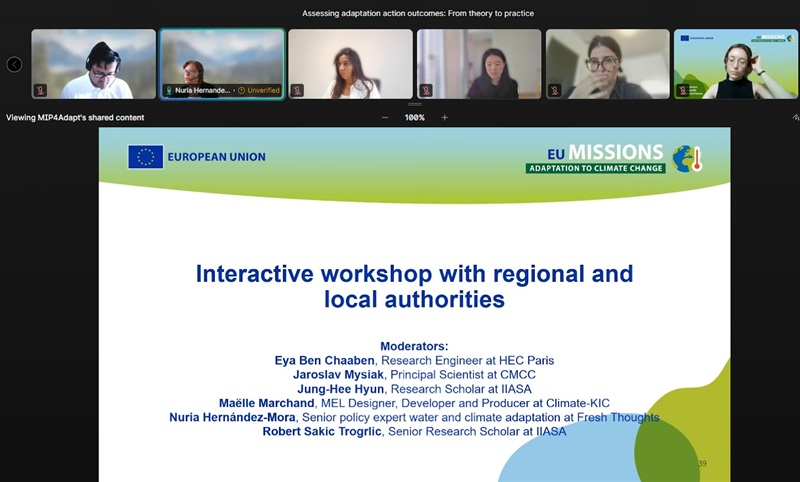
This was the central question discussed during the second interactive workshop co-organised by UNDERPIN, together with the Thematic Working Group for Monitoring, Evaluation, and Learning (TWG-MEL) and the Mission Implementation Platform for Adaptation to Climate Change (MIP4Adapt) on June 26th 2026.
The interactive session brought together 103 local authorities representatives, researchers working with EU Mission on Adaptation to Climate Change projects from across Europe.
Building on the reflections from April´s workshop, Developing a Framework for Tracking Adaptation Outcomes, participants explored how monitoring, evaluation and learning (MEL) tools can be used in practice to evaluate the effectiveness of adaptation initiatives.
The workshop was structured around three themes:
- Developing meaningful adaptation indicators.
- Designing accessible user-friendly dashboards and visualisation tools.
- The usability of adaptation monitoring frameworks for local and regional authorities.
Several cross-cutting insights emerged from these discussions:
– From measuring activities to assessing impact: Adaptation indicators need to move beyond output-focused approaches towards outcome- and impact-oriented ones capable of capturing long-term resilience effects.
While reflecting specific sectors such as water, agriculture, and health, the participants highlighted that indicators become more useful when they are clearly defined, include measurable targets and timefr- ames, and are explicitly linked to actions. Local context sensitivity, governance discrepancies, and data availability were mentioned as elements shaping the process.
– Dashboards that tell a story: Dashboards and visualisation tools play an important role in supporting the interpretation and learning of adaptation actions and strengthening evidence-informed decision-making. For that to happen, dashboards need to be understood as more than raw data repositories.
They should combine intuitive visualisation features, such as interactive maps and charts, with contextual information through narrative summaries, and storytelling. Moreover, they should allow users to navigate from broader to more detailed analyses.
– Context, flexibility and trust as pillars: MEL systems need to be flexible and adaptive to the context, rather than be conceived as one-size-fits-all reporting tools. Building trust among stakeholders and ensuring access to information are key ingredients for developing and sustaining robust and meaningful MEL frameworks, regardless of their stage.
Experiences from Lombardy (Italy), the Banská Bystrica Self-Governing (BBSG) Region (Slovakia) and the CLIMAAX project, shared during the workshop, were used to illustrate the different stages of MEL maturity and experiences across Europe, and the need to actively adjust to distinct contexts and capabilities.
The recording of the workshop is available on the Mission For Adaptation Youtube’s website and the workshop report is available on UNDERPIN website
Looking ahead
Overall, participants agreed that while a single standarised MEL framework is neither feasible nor desirable, shared principles, interoperable indicators and common reporting approaches can strengthen collective learning and collaboration across projects and governance levels.
Future planned activities of the TWG MEL include a workshop in the fall of 2026 to conduct an in-depth discussion and evaluation of the draft adaptation MEL framework developed by UNDERPIN that will take place and a policy outlook roundtable, based on the collective insights emerging from the two TWG discussions, planned for 2027. The event will explore relevant questions and emerging challenges for policy makers and adaptation practitioners.
About UNDERPIN
UNDERPIN is a Horizon Europe project supporting the objectives of the EU Mission on Adaptation to Climate Change. The project brings together partners and pilot regions from across Europe to design, co-develop, and validate a new monitoring, evaluation, and learning (MEL) framework and outcome indicators that address critical gaps in climate adaptation monitoring while fostering a coordinated approach to resilience-building in Europe.
Find UNDERPIN in the Mission Portal.