
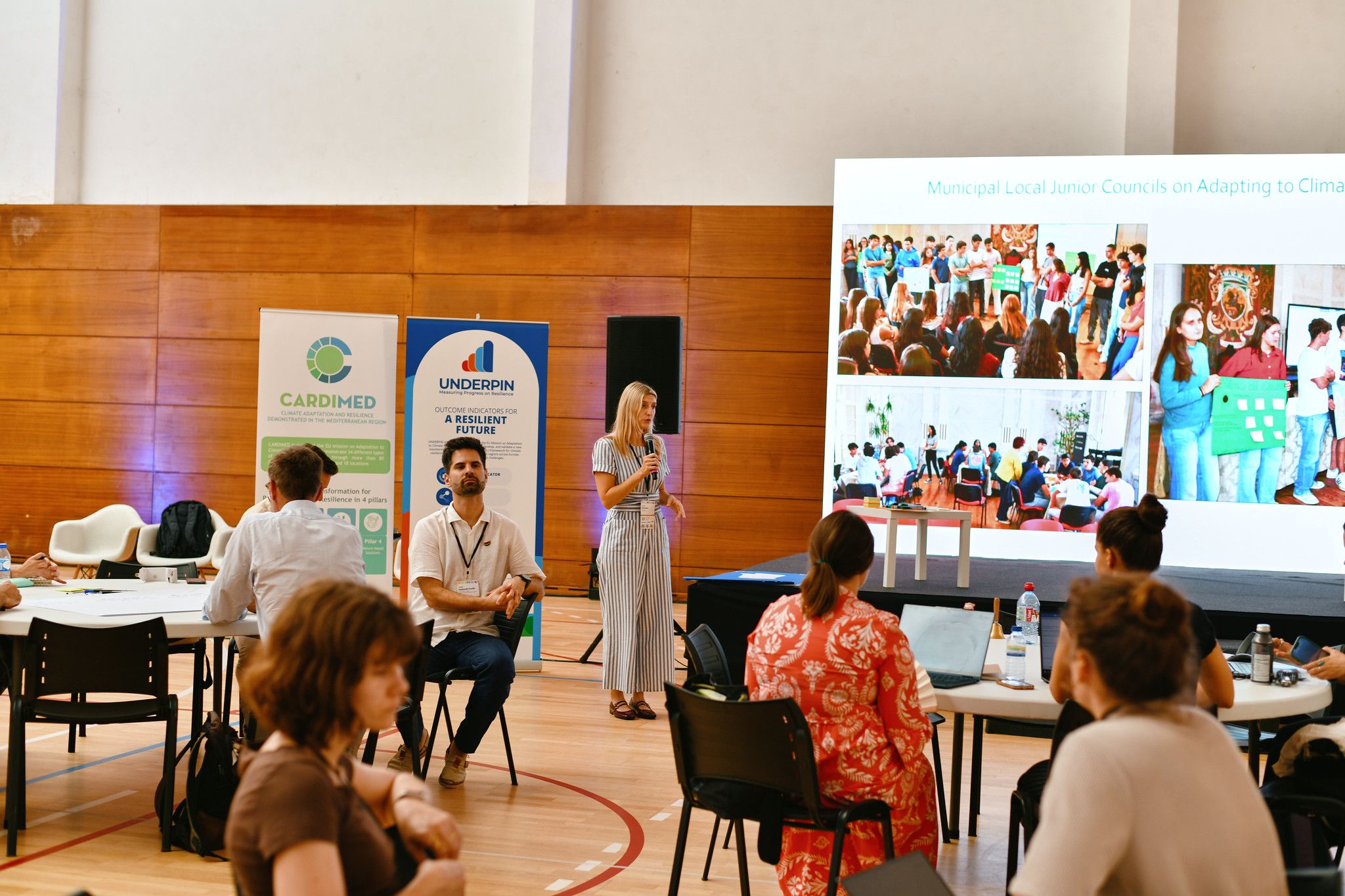
UNDERPIN played an active role at EURESFO 2026, contributing to discussions on how regions and local authorities can strengthen climate adaptation through more effective Monitoring, Evaluation and Learning (MEL) systems.
As part of the conference, UNDERPIN co-organised the interactive workshop “The MEL Clinic: Diagnosing and Strengthening Regional and Local Learning Systems” together with CARDIMED and Pathways2Resilience, bringing together practitioners, researchers and policymakers to explore how MEL can evolve beyond a reporting requirement into a practical tool for continuous learning and adaptive governance.
The session also drew on experiences from Pathways2Resilience, another project under the EU Mission on Adaptation to Climate Change, and the Central Alentejo Region in Portugal. These offered concrete examples of how local and regional authorities are embedding learning into climate adaptation processes.
Moving beyond reporting
One of the central messages emerging from the workshop was that effective MEL is about much more than collecting indicators and producing reports. Instead, it should support reflection, learning and better decision-making throughout the adaptation journey.
As Dr. Sanchita Bakshi from IIED Europe and one of UNDERPIN’s adaptation MEL experts noted: “We have to design systems away from what we are traditionally used to.”
This shift requires creating monitoring systems that not only measure progress but also capture the complexity of adaptation and enable stakeholders to respond to changing circumstances.
Learning from local experiences
Drawing on the experience of Portugal’s Central Alentejo Region, João Sardinha highlighted the importance of combining quantitative evidence with local knowledge and lived experience: “It is not only quantitative data that matters, but people’s perception.”
Throughout the interactive discussions, participants explored how MEL can help regions and communities: address data gaps and fragmented information; support adaptive decision-making by learning from both successes and challenges; better understand community needs, perceptions and priorities; strengthen communication and learning across different levels of governance.
The workshop also showcased good practices from CARDIMED and Pathways2Resilience, demonstrating the value of establishing dedicated local monitoring teams, developing indicators that reflect local priorities, and planning measurement approaches early in the implementation process.
MEL as participatory governance
A recurring theme throughout the session was the importance of participatory approaches. Participants discussed how citizens should be actively involved not only in adaptation planning but also in designing and implementing monitoring, evaluation and learning processes.
By using participatory evaluation methods, MEL can become a powerful mechanism for ensuring that adaptation actions respond to local realities while strengthening trust, transparency and collaboration between communities and decision-makers. The discussions also raised important questions for future work:
- How can MEL frameworks be adapted to diverse regional and local contexts?
- How can MEL better support participatory decision-making and meaningful citizen engagement?
- How can learning generated through MEL be shared more effectively across governance levels to accelerate climate adaptation?
UNDERPIN’s contribution within the Adaptation Mission
During EURESFO 2026, Sophie Berger of the Mission Secretariat, also highlighted the strategic importance of the UNDERPIN project within the EU Mission on Adaptation to Climate Change, emphasising the project’s role in advancing practical approaches for adaptation monitoring, indicators and learning across Europe.
Looking ahead
The rich exchange of ideas at EURESFO 2026 reinforced that monitoring, evaluation and learning are not simply technical exercises—they are essential building blocks for more resilient, adaptive and inclusive climate governance.
UNDERPIN will continue working with its partners to develop practical MEL approaches that help regions learn from experience, engage stakeholders more effectively, and translate knowledge into stronger climate adaptation action across Europe.