
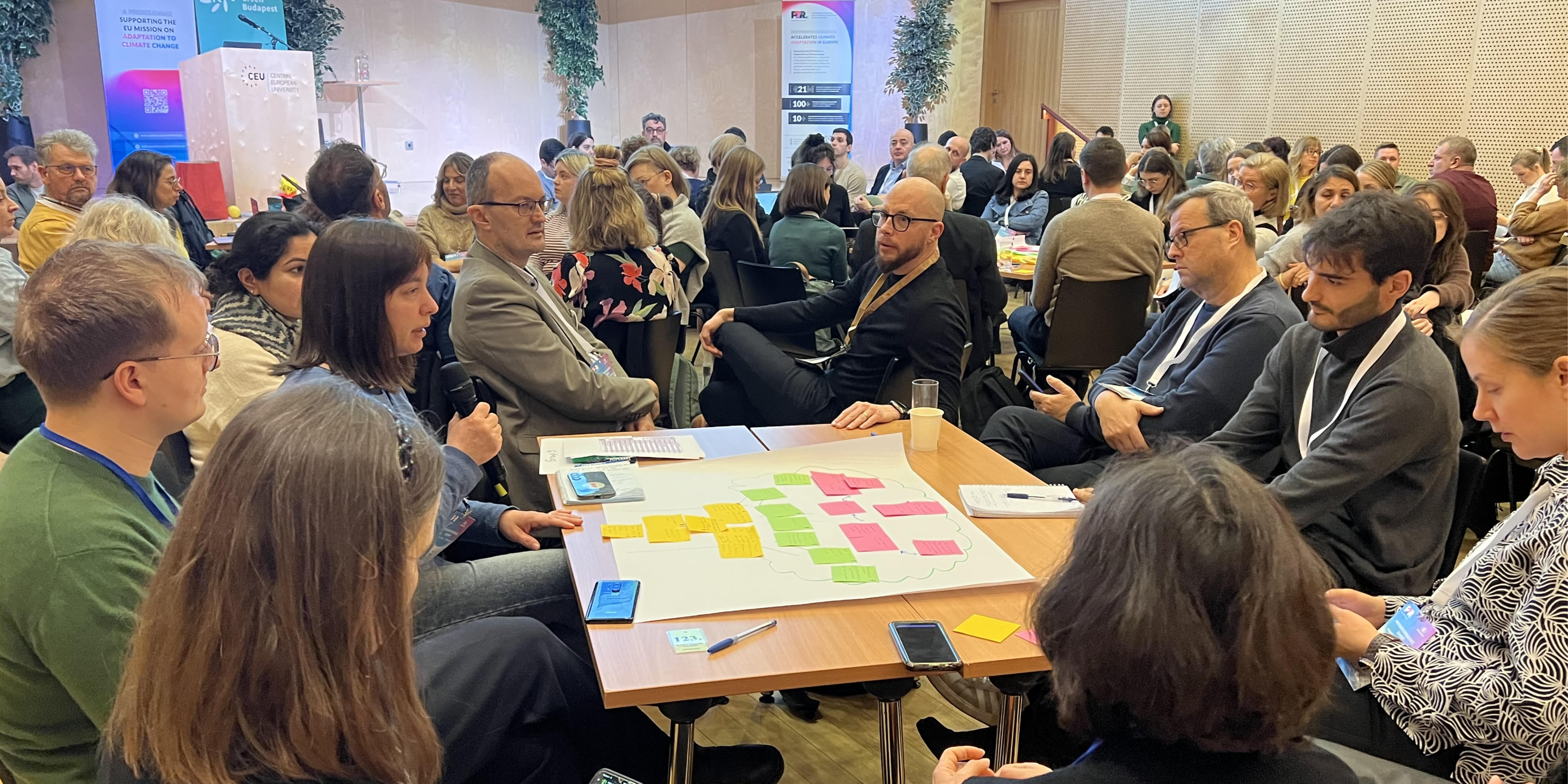
At the recent Pathways2Resilience (P2R) Summit, another project under the EU Mission on Adaptation to Climate Change, partners playing a role in both P2R and UNDERPIN helped facilitate a timely and candid exchange between European regions navigating the realities of climate adaptation on the ground.
Facilitated by TECNALIA Research & Innovation and IIED Europe — both active in EU Mission Adaptation projects — the session brought together regions from across the two P2R regional cohorts to reflect on how collaboration and shared learning can be strengthened across different stages of resilience maturity.
Central to the discussion was adaptive monitoring, evaluation and learning (MEL) — increasingly recognised not merely as a technical exercise, but as a core governance challenge for regions striving to meet ambitious EU Mission objectives.
Several themes emerged.
First, the diversity of starting points across Europe is striking. While Mission-level ambitions are high, regional authorities operate with varying levels of institutional readiness. Many are managing climate risk while overextended with limited staff and resources. Participants emphasised the need for MEL approaches that are adaptive and realistic — frameworks that support progress without overwhelming already constrained administrations.
Capacity gaps remain a persistent barrier. Even where monitoring systems exist, regions reported difficulty identifying meaningful indicators that capture progress without becoming overly burdensome. The technical expertise required to design robust MEL frameworks is not always readily available at regional level.
A fundamental question also surfaced: what exactly should be monitored? Some regions prioritise tracking the evolving impacts of climate change itself, while others focus on assessing the effectiveness of adaptation measures. Beyond compliance and reporting, participants explored how MEL systems can become active tools for steering and improving adaptation strategies over time.
Attribution presents an additional layer of complexity. Demonstrating the causal impact of adaptation policies is challenging, particularly when benefits unfold over long timeframes that do not align neatly with short political cycles. Counterfactual approaches — showing what might have happened without intervention — are often resource-intensive and difficult to operationalise.
Underlying all of these challenges are structural resource constraints. Even with increased European support, many regional administrations face limited time, staffing and budget to embed resilience strategies and MEL systems into everyday governance. This raises practical questions about prioritisation, sequencing and how to integrate monitoring into existing processes rather than treating it as an additional requirement.
The exchange provided a space not only to showcase regional progress, but also to openly discuss constraints and trade-offs. As regions continue to scale up adaptation efforts, strengthening collaboration across Europe will be essential to translating shared learning into collective progress on resilience governance.
The conversation continues: how can adaptive MEL be designed to match high ambition with limited capacity — and how can it genuinely support better decision-making over time?